
 368.54


FC Ararat Yerevan celebrates 80th anniversary
14 minute read
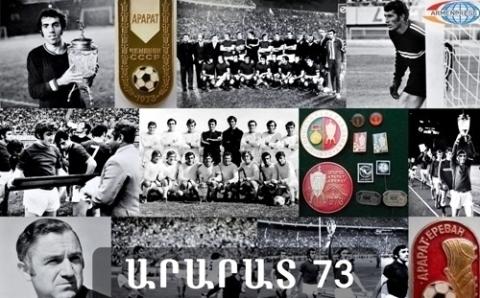
YEREVAN, MAY 11, ARMENPRESS. The legendary FC Ararat Yerevan celebrates the 80th anniversary of its establishment. A football team was created in Yerevan within the Spartak sports society in 1935. The team was headed by Vramshapuh Merangulyan. At first the team played in the republican-level tournaments and the first trophy they got was the Armenian SSR Cup which they won in 1940 under the name Dynamo. The USSR championship and Cup were not played in the next four years because of the Second World War.
The USSR Cup tournaments were resumed in 1944 and Dynamo participated in them. They were to meet with Dynamo Tbilisi, but the match did not take place through the Yerevan club’s fault. Dynamo Yerevan played under the guidance of Mikhail Sushkov in the 1946 season. In 1947 the team won the silver prize playing in the Transcaucasia Zone of the Second League. Dynamo Yerevan outplayed Krylia Sovetov Tbilisi at home in that championship and achieved their best result for that time – 7:1. In the 1948 season Dynamo was to appear in the First Group (the Top League then), but after 30 games the Yerevan and 15 more clubs were eliminated. Those 16 clubs continued to play in the lower league. In the next season, playing in the Second Group Dynamo improved their results and won the first place in the South Zone.
The team won 13 matches out of 18. However, the first place in the zone did not guarantee promotion to the upper tier. According to the USSR championship regulations six winners in the Second League Zones were to play one round between themselves at the final stage. Having played five games Dynamo Yerevan came up third in the tournament standings, which signified the club’s promotion to the First Group.
Dynamo Yerevan debuted in the USSR Top League in 1949. The team performed poorly and ended in the 16th position. They lost in the first two rounds and scored a win in the third round against VVS Moscow in the home game. Dynamo Yerevan managed to outdo only those of their opponents who were positioned in the lower part of the tournament standings, and twice in away games. They received three large defeats: two from Lokomotiv Moscow and CDKA (both 0:6) and one from Dynamo Tbilisi (1:6). However, in spite of their poor performance the club remained among the next season competitors as the two bottommost clubs occupying the 17th and 18th positions were to be demoted. As to the battle for the Cup it came to an end right in the first stage, in the game against Dynamo Stalinabad. The team began to play more vigorously in the 1950 season. Their first defeat, from Zenit Leningrad, was fixed only in the 4th round. The team scored 31 points, the same as Dynamo Kiev, but the latter had a better goal difference, and Dynamo Yerevan was relegated to Class B. In the USSR Cup tournament, having outpaced their weaker opponents the Yerevan team confronted Dynamo Kiev in the 1/16 finals. The game was played in Kiev. Fighting stubbornly, the Yerevanians scored the 3:2 victory. In the 1/8 finals they met with Dynamo Moscow and lost 0:7
The team’s performance improved in the second half of the 1950s. The third place in the 1956 championship was their worst result. Being runners-up three times, the Yerevan team, now named Spartak, at last succeeded in attaining “minor gold” in 1959 and got to the higher class. In 1960 the team debuted in Class A of the USSR championship. The first step proved to be troublesome. Playing the first game on their home ground Spartak Yerevan were beaten by Dynano Moscow 0:4. The team came out ninth in that season. Having played three more seasons in Class A they eventually descended to Class B. Two years later Spartak Yerevan came up first and returned to Class A. After that the team went over to the Armenian republican sports society Ashkhatank and was renamed Ararat.
Ararat appeared in the USSR Top League regularly beginning from 1966. Alyosha Abramyan and Alexander Syomin began to play with the team that year and were acknowledged as the best debutants of the season. Norik Demirchyan was awarded the same title in the next season. The team’s performance was quite satisfactory until 1970 as it was virtually being reborn. Players from other Armenian clubs, who demonstrated disposition for leadership, were invited to play for Ararat: Ishtoyan and Zanazanyan from Shirak Leninakan (the latter would be the team’s captain afterwards), and Nazar Petrosyan from the Armenian republican football school; Andriasyan and Markarov came from Neftchi Baku.
Ararat won the silver medal in the 1971 USSR championship under the guidance of Nikolai Glebov. It was the first major achievement of the Armenian club.
Six Ararat players were put on the list of the 33 best Soviet footballers of the season: Ishtoyan, Andriasyan, Markarov, Zanazanyan, Kovalenko, and Mesropyan. The team played with no less zeal in the next season and was given the prize “To the Aggressive Guest”, but ended the fourth lacking just one point to climb the winners’ podium. Ararat debuted in Euro Cups on September 13, 1972. They played their first match in Larnaca, Cyprus, against EPA and scored their first victory with the minimal score 1:0. The return game also ended with 1:0 in favour of Ararat. The Swiss Grasshopper were their rivals in the next stage. Without meeting serious resistance Ararat won 3:1 in the away game and 4:2 at home and passed to the third round where they encountered Kaiserslautern of Germany. The opponents exchanged 2:0 scores in their home games. Extra time had not revealed the winner. The German side turned to be more successful than Ararat who eventually lost 4:5 in the penalty shootout.
Ararat reached its historical peak in the 1973 season, when the legendary footballer Nikita Simonyan headed the team and led it to its major success. Ararat won the USSR championship that year; it also won the USSR Cup in the memorable final game with Dynamo Kiev thereby making the golden double. The team was awarded four prizes for its remarkable performance: “To the Aggressive Guest”, the Grigory Fedotov Prize, “For the Big Score”, and “For the Best Goal Difference”. Eight Ararat players were put on the list of the 33 best Soviet footballers of the season.
As it chanced, Ararat alternated successful seasons with relatively unsuccessful ones. The team found themselves outside the prize winning trio in the 1974 championship, and in the Cup quarterfinals they stumbled over Shakhtyor Donetsk. In the autumn Ararat debuted in the European Champion Clubs’ Cup. Their opponents in the first two rounds, Viking and Cork Celtic had not put up serious resistance and lost to Ararat 2:6 and 1:7, respectively. In the quarterfinals Ararat encountered Bavaria Munich, the current holder of the trophy.
The guest scenario of the game proved to be ineffective for Ararat; they lost 0:2. In the return match in Yerevan the team played robustly in defence and even delivered a goal to the formidable opponent’s net, but one goal was not enough to continue fighting in the main UEFA tournament. Eduard Markarov was named the best striker of the tournament (together with Gerd Mller).
In 1975, under Victor Maslov, Ararat repeated half of the achievement they gained in 1973 having won the USSR Cup. Being one down in the beginning of the final game with Zarya Voroshilovgrad Ararat made a levelling goal, then scored one more and thus overpowered their opponents 2:1. As to the championship, Ararat ended up 4 points behind the leading trio. Khoren Oganesyan, the future star of Armenian football, commenced on his brilliant career that year and was granted the prize as the best debutant of the season. The team appeared in the Cup Winners’ Cup for the first time that autumn. Ararat beat Anorthosis of Cyprus rather easily (10:1), but fell back in the next round, where West Ham United London won by scoring 1:1 and 1:3. That was Ararat’s last appearance in Euro Cups in the Soviet history of the club.
The team’s standing was obscure at the beginning of 2010. While preparations for the new season were in full swing in all Armenian teams, Ararat had not even started training. Tigran Esayan, former Ararat player, was appointed head coach. The club did not participate in the Armenian The club management gave up acquiring legionaries on the ground that foreign players could hardly do more good to the team than domestic footballers in the First League championship. Instead, young local footballers were enrolled to play for Ararat. The team led by Esayan won in the First League and came back to the Premier League. The palms of the League top goalscorer went to the club’s young forward Gevorg Karapetyan.
Esayan resigned from the post of head coach on February 16. The reasons of his resignation were the attitude of the club management to the team’s preparative at the time of autumn-spring training sessions and the absence of fresh players who might be able to strengthen the team in matches with Premier League clubs. Edgar Safaryan and Alyosha
Abramyan, head coach assistants, were in charge of the team’s training for a short period of time before the championship opening. However, on March 5, in the first round of the 2011 championship, the team was fielded against Banants by Arkady Andriasyan who was not head coach at the moment and did not have category “A” license. Andriasyan was officially put at the head of the Yerevan team three days later.
Albert Safaryan, who had been assistant head coach in the club, replaced Andriasyan in the latter’s post in February 2012. However, the coaching staff shuffling produced no effect on the team’s performance and results. Ararat continued ranking as an outsider.
After a conference with Ararat owner Grach Kaprielyan in the evening of July 5 it was announced that Abraam Khashmanyan would head the club. The state of the team and conditions of its existence were deplorable, and that was the major problem that Khashmanyan intended to rectify in his new position. He also noted that only local footballers would play in the team.
Best players: Ararat players Arkady Andriasyan, Oganes Zanazanyan (1972) and Khoren Oganesyan (1980) were bronze prize winners of the Munich and Moscow Olympiads. Khoren Oganesyan played 35 matches with the USSR national team and scored 6 goals. The best players in the post-Soviet period were Marcos Pizzelli (2006-2008), who played in the Armenian national team and in Kuban Krasnodar, and Artur Minasyan (captain) over many years and to this day.